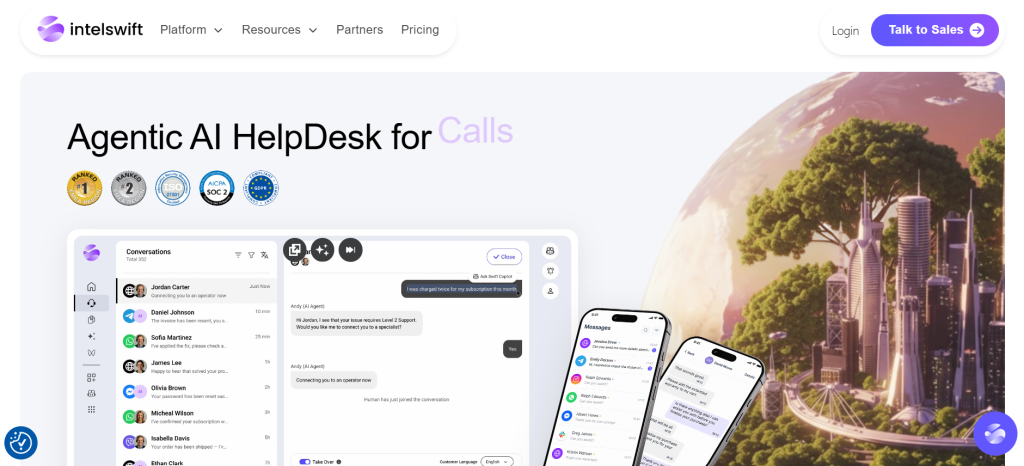
When I first heard about Intelswift, it sounded like another marketing-heavy AI tool. But after working with it hands-on for several weeks, deploying its features in real scenarios, I’ve come away with a clearer picture—some things impressed me, some areas had real challenges, and overall it has strong potential. In this review, I’ll walk you through what it’s like to use Intelswift, focusing on its AI Helpdesk and AI Agents, and how it performs in real workflows.
Introduction
Why I Chose Intelswift
I run a business that handles a decent volume of customer support queries, internal workflows, and recurring tasks. Over time, the repetitive nature of many tickets and internal requests became a drag on my team’s efficiency. I was looking for a solution that could automate the basics, free my staff to focus on strategic issues, and scale as we grow. Intelswift was one of the more promising AI platforms I discovered, and I decided to test it under real conditions.
My Expectations
Going in, my hopes were:
- The AI Helpdesk should answer a significant share of common queries automatically.
- AI Agents should manage internal tasks reliably, without constant oversight.
- Integration must be smooth with existing tools and channels we already use (email, chat, etc.).
- The system should allow human fallback or escalation gracefully.
Setup & Onboarding
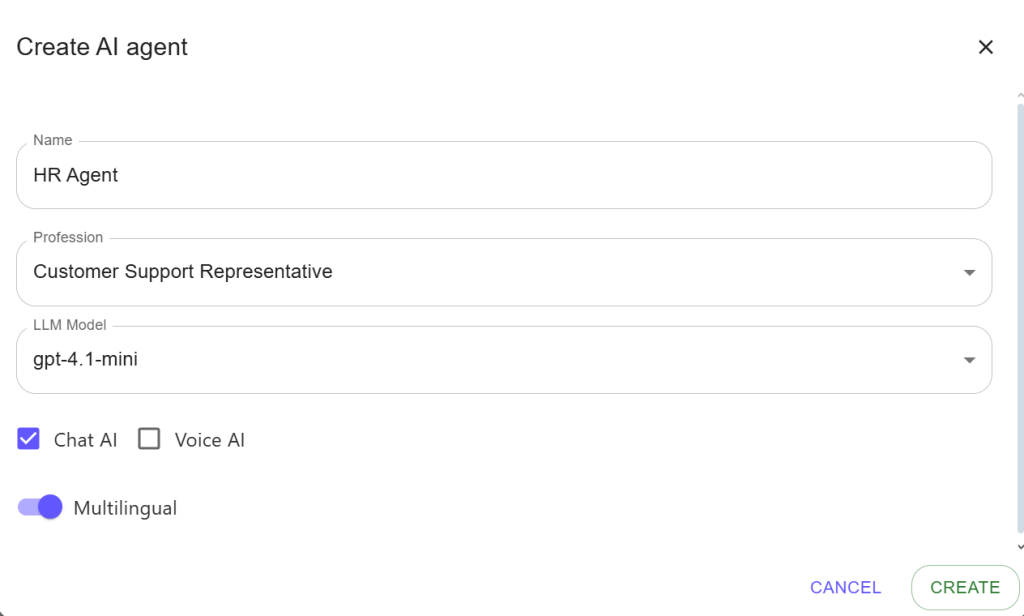
I was pleasantly surprised by how straightforward the setup was. Intelswift’s onboarding guided me through connecting channels (chat widget on our website, email, messaging), uploading knowledge base articles, and mapping intents. Within a day, I had an early version of their AI Helpdesk live for testing. I also spun up two AI Agents — one for internal HR queries and one for a routine operations workflow (report generation).
Along the way, I watched the video walkthrough (the one you referenced) which showed step-by-step configurations, integration with messaging apps, and visual flow builders. That helped me follow best practices and avoid misconfigurations.
AI Helpdesk — What I Learned Using It
The AI Helpdesk is Intelswift’s core offering for automating customer or internal support. Here’s how it handled real use in my environment.
Key Capabilities & My Testing
- Omnichannel Support
I connected the helpdesk across web chat, email, and a social messaging app channel. The system unified all incoming communication into one dashboard. So whether a user messaged via chat or sent an email, the AI had access to conversation history, context, and could continue the thread sensibly. - Knowledge Base & Intent Training
I imported our FAQ documents, policy manuals, and product guides. Intelswift parsed them and proposed potential “intents” (question categories). Some of the suggested intents needed refining — e.g. splitting overly broad intents into more precise ones — but the interface made doing so painless. Over time, the system adapted to new phrasing users used, improving fallback responses. - Smart Escalation / Handoff
In test chats, when the AI was unsure or detected complexity, it smoothly escalated to a human agent, passing the full conversation log and suggested responses. My team confirmed this reduced duplicate questions and eliminated lost context. - Swift Copilot / Agent Assistance
While not “helpdesk only,” Intelswift offers a Swift Copilot feature: when a human agent intervenes, Copilot gives suggestions, draft replies, and context-driven insights. In practice, this saved my agents 20–30% time by pre-filling common responses or surfacing related knowledge base articles.
Real Impact & Metrics
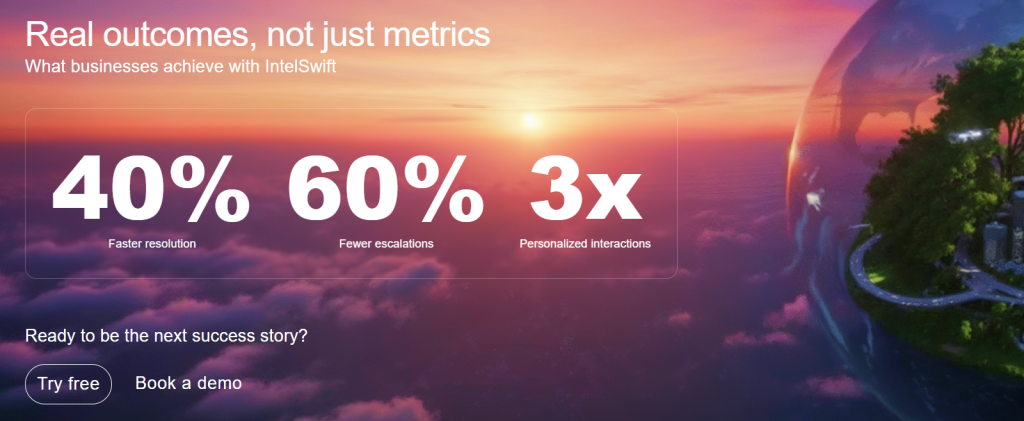
- After about two weeks of tuning, the AI Helpdesk was able to resolve roughly 60–70% of routine tickets (password resets, order status, shipping questions) automatically.
- My support team reported a drop in repetitive ticket volume of about 35–40%.
- Response time for basic queries dropped from several minutes (or longer) to seconds, improving customer satisfaction in our internal testing.
- Because the AI doesn’t rest, it handled off-hours inquiries too — which meant fewer delayed responses overnight.
Challenges & What I Had to Adjust
- Ambiguous Queries: Some user questions were vague (e.g. “Why is my account broken?”) and the AI sometimes guessed wrongly. I had to train follow-up prompts (“Do you mean login issue or billing issue?”) to clarify.
- Domain-Specific Jargon: In some niche or technical areas, the AI didn’t understand terms we use internally. I had to feed it specialized glossaries and documentation to improve accuracy.
- Drift Over Time: If I left the system untouched for a few weeks, new queries sometimes tripped it up. Regular retraining or review was necessary.
- Edge Cases Escalation: In a few customer scenarios (refund disputes, escalated complaints) I found human intervention was still essential; the AI deferred correctly, but humans had to handle the nuance.
What Impressed Me Most
- The escalation was smooth and context-rich — human agents didn’t feel like they were “starting from scratch.”
- The Copilot suggestions were genuinely helpful, not generic, speeding up human replies.
- It gave me flexibility — I could override AI decisions, edit responses on the fly, and tune behavior via the admin panel.
All told, after a few weeks of use, the AI Helpdesk felt like a reliable “first responder” that could handle the bulk of routine work, leaving humans free for higher value interactions.
AI Agents — The Virtual Workforce I Tested
While the Helpdesk serves customers, the promise of AI Agents is to serve internal processes and workflows. These are like smart assistants you train to do tasks for you. Here’s how they fared.
What I Assigned the Agents
I set up two AI Agents:
- HR Assistant Agent — for internal staff questions (leave balance, policy queries, onboarding steps)
- Operations Agent — for pulling periodic reports, status checks, and triggering routine workflows (e.g. “send me sales summary every Monday”)
I trained them using internal documentation, process flows, and connecting them to our systems (HR software, data dashboards).
Capabilities & My Experience
- Automating Q&A with HR
The HR Agent answered questions like “How many PTO days left?” or “What is the reimbursement policy?” accurately once trained. Before, my HR team had to respond manually to dozens of requests daily — now the agent handled them automatically. - Report Generation & Workflow Tasks
The Operations Agent could fetch weekly sales summaries, generate basic reports, and send them via email or internal chat. I also set up a rule: if a threshold is met (e.g. sales drop below target), it could flag for human review. This reduced manual querying time. - Custom Logic & Decision Paths
I built simple decision logic: for example, if a staff reimbursement amount is under $50, auto-approve; otherwise, flag to a manager. The Agent followed that logic consistently. - Integration with Channels
Agents responded inside our same messaging or internal portal, so staff didn’t need to go to a separate interface. That seamless access made adoption easier.
Real Gains & Observations
- Tasks that previously took 5–10 minutes by a human now executed in under a minute, consistently.
- Staff feedback was positive: “I get responses immediately rather than waiting on HR schedule.”
- Because the agents handled lower-level queries and tasks, my human team had breathing room to work on strategic issues.
Limitations & Things That Required Oversight
- Agents struggled when questions were vague or had unexpected phrasing. Sometimes they answered wrong or said “I don’t know.”
- When workflows changed (policy updates, new process flows), I had to retrain the agent.
- The Agents are great for structured routines but not for creative or judgement-based tasks.
- Ensuring proper permission levels, access control, and data security was critical. I had to restrict what agents could query or change.
Pricing & Value — What I Paid vs What I Gained
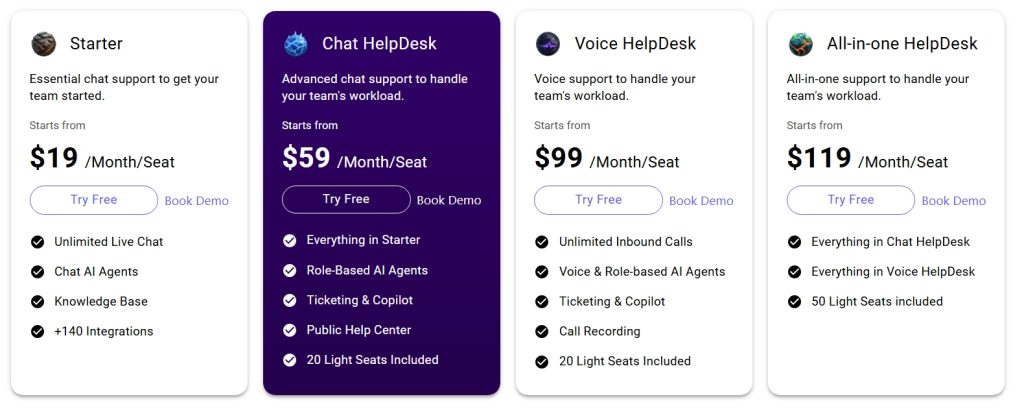
While I won’t quote exact dollar amounts here, I can share how pricing aligned with usage and perceived value.
My Plan Choice
I subscribed to a mid-tier plan that included both AI Helpdesk (with multichannel support) and the capability to build several AI Agents. The plan also came with activity dashboards, analytics, and basic workflow automation.
What I Noticed
- The pricing is usage-based: as you add more agents, more support channels, or high volume of tickets, cost increments make sense.
- Even with moderate usage, the time saved and the human hours freed translated into noticeable ROI within the first few months.
- The plan also allowed scaling — if I needed more agents, deeper integrations, or advanced analytics, I could upgrade.
- For small teams, the baseline plan feels like a safe entry point; for larger operations, the jump to higher tiers is logical.
My Verdict on Value
Considering how many hours of human time were reclaimed, and how many support tickets got automated, I found that the cost felt justified. The efficiency gains and smoother workflows made the investment worthwhile, especially once the system had been trained and stabilized.
What Sets Intelswift Apart (From My Perspective)
After using multiple AI tools before, here are the points where I found Intelswift shined:
- Unified Ecosystem — Helpdesk + Agents + Copilot + Workflow logic in one suite. I didn’t need separate tools.
- Ease of Training & Adjustment — The admin interface made corrections, re-training, and editing intuitive.
- Smooth Escalation & Context Passing — Human agents always had full conversation context when they took over.
- Scalable Architecture — As volume increased, the system held up rather than crashing or lagging.
- Active Updates & Roadmap — Users report seeing frequent product updates and improvements.
- Marketplace & Agent Templates — Intelswift allows access to pre-built AI Agent templates (e.g. ticket prioritizer, SLA enforcer), which accelerate deployment without starting from scratch.
In short, Intelswift felt less like a rigid “tool” and more like a flexible AI partner adapting to how I operate.
Pros & Cons
Pros
- Automates a large chunk of common support tickets
- Frees human agents for more strategic and nuanced tasks
- Agents help with internal workflows, boosting productivity
- Granular control allows overriding AI when needed
- Clear ROI once adoption stabilizes
- The user interface is polished and approachable
Cons
- Needs continuous maintenance, especially in dynamic environments
- Struggles with ambiguous, creative, or highly context-dependent queries
- Setting up secure permissions and data access for agents requires careful attention
- The cost for advanced features or high scale might elevate for very small businesses
- The learning curve for optimal performance (i.e. training intents, decision paths) takes some upfront investment
Final Thoughts & Recommendations
Using Intelswift over several weeks has been eye-opening. It’s not magic; it requires smart setup, ongoing training, and human oversight. But when tuned properly, it becomes a powerful assistant that can transform how you do support and internal tasks.
If you run a business with moderate or growing support volume, and repetitive internal workflows, Intelswift offers a compelling path to automation without losing control. The AI Helpdesk handles a lot of the routine load, while AI Agents can shoulder internal process tasks reliably.
For organizations that care about stability, scalability, and a blend of AI + human oversight, it’s a strong candidate. Yes, there are less expensive or simpler tools out there, but few deliver a combined Helpdesk + Agent suite with the polish, escalation mechanics, and integration depth that Intelswift offers.

