Every business has competitors.
Some are obvious. You know their names. You see their ads. You check their websites once in a while.
But some competitors are quiet. They grow slowly. They test new markets. They change their pricing. And by the time you notice them, they are already taking attention from your customers.
That is the problem BrandScout tries to solve.
Brandscout is a market intelligence and competitive intelligence platform built for founders, growth teams, consultants, and strategists. It helps users discover competitors, organize market data, run strategic analysis, and turn those insights into action plans. Not just reports. Actual direction.
What Is BrandScout?
BrandScout is a competitive intelligence platform that helps businesses understand their market better.
In simple words, it helps you answer questions like:
- Who are my real competitors?
- Which hidden players are entering my market?
- What are their strengths and weak points?
- Where are the market gaps?
- What should we do next?
The platform works like a living competitor database. Instead of keeping random notes in spreadsheets, BrandScout creates structured competitor records with positioning, strengths, movements, and market context. It also keeps intelligence updated over time through manual updates and automated signals.
BrandScout Workflow
BrandScout’s workflow is simple to understand. It moves from discovery to action.
1. Discover
The first step is competitor discovery.
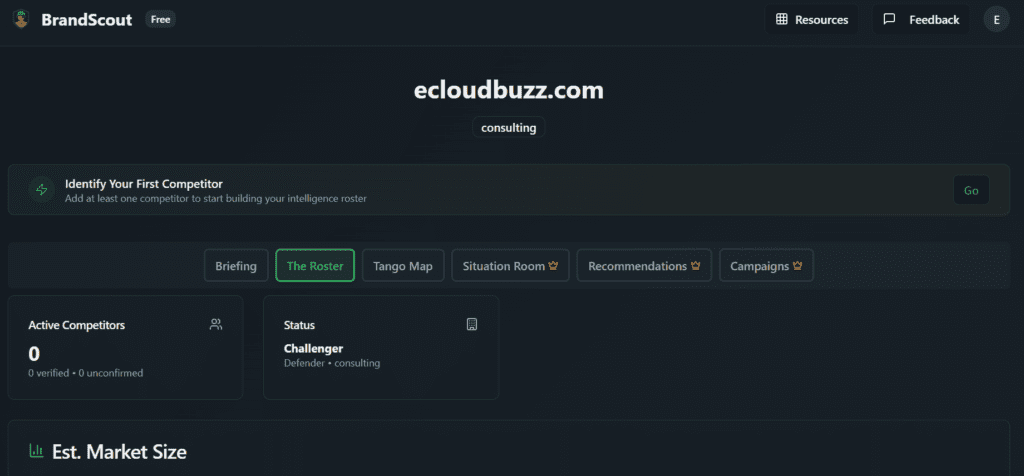
BrandScout’s “The Roster” helps map your competitive landscape. It does not only show the competitors you already know. It also helps surface hidden and emerging players that may be shaping your market quietly.
2. Analyze
After discovery, the data moves into the “Situation Room.”
This is where scattered market information becomes more useful. BrandScout helps map threats, opportunities, and gaps against your actual position. It also supports strategic frameworks like SWOT, PESTEL, Porter’s Five Forces, Ansoff Matrix, and Value Proposition Canvas.
3. Execute
Next comes Strategic Guidance.
BrandScout uses the market data to generate recommendations. These are not just broad ideas. They are based on your competitive position and the data inside your competitor database.
4. Deploy
The final step is turning strategy into campaigns.
BrandScout can translate recommendations into 90-day campaign plans with tasks and milestones. This makes it useful for teams that do not want only analysis, but also a practical roadmap.
Key Features of BrandScout
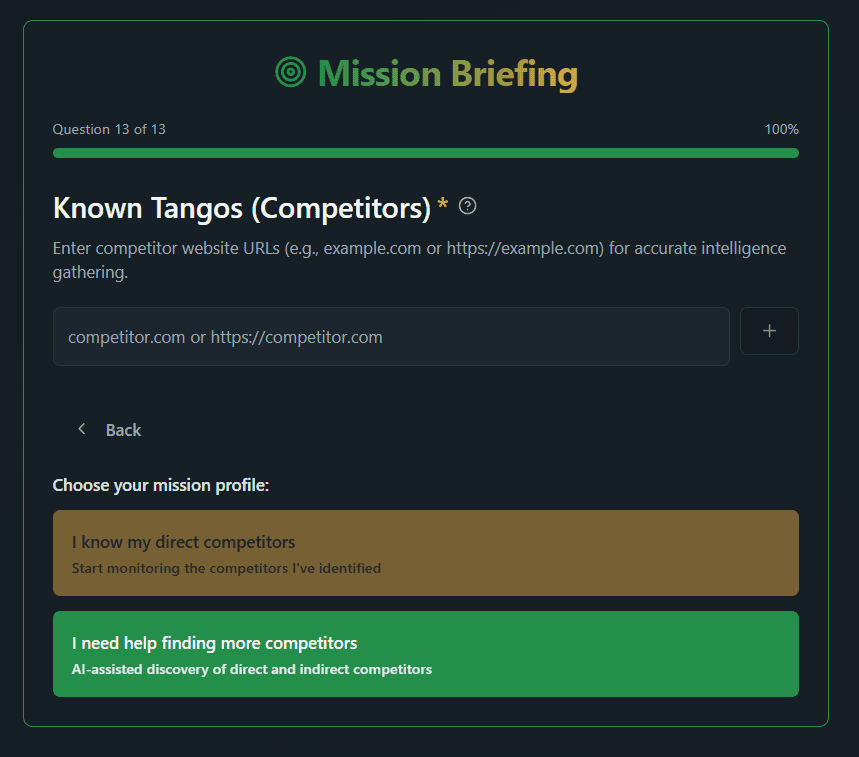
1. Competitor Database
BrandScout gives users a structured competitor database called The Roster.
This is useful because spreadsheets often become messy. Someone adds a note. Someone forgets to update it. After a few weeks, nobody trusts the file.
BrandScout keeps competitor information organized and searchable. Better for teams. Better for long-term tracking.
2. Quick and Deep Search
The platform offers Quick and Deep Search competitor discovery.
Quick Search is useful when you want fast market mapping. Deep Search goes further and uses your existing competitor database to find companies that lighter tools may miss. BrandScout says it uses public sources like competitor websites, market data, industry reports, regulatory filings, and signal monitoring.
3. Situation Room Analysis
The Situation Room is where BrandScout becomes more strategic.
It runs proven frameworks on your actual competitor data. This includes PESTEL, Porter’s Five Forces, SWOT, Ansoff Matrix, and Value Proposition Canvas. For founders and growth teams, this can save many hours of manual research.
4. HORIZON AI Recommendations
BrandScout’s HORIZON AI turns analysis into recommendations.
This is helpful because data alone can be tiring. You may know ten things about your market, but still not know what to do next. HORIZON AI tries to close that gap by suggesting strategic moves based on the market picture.
5. TACNET Campaigns
TACNET helps convert recommendations into campaign plans.
Instead of ending with a report, BrandScout can create 90-day plans with milestones and tasks. This is good for teams that want to move from “we should do something” to “this is what we do next.”
6. Battlecards and Listening Posts
Premium users also get 1-on-1 battlecards and Listening Posts for market surveillance.
Battlecards can help sales teams understand how to position against specific competitors. Listening Posts help users stay informed when competitors move. Useful, especially in fast markets.
BrandScout Pricing
BrandScout pricing is simple.
Freemium Plan — Free Forever
The Freemium plan includes:
- Competitor Database
- Quick and Deep Search Competitor Discovery
- Competitor Research
- Tango Map
- Business Canvas Analysis
It requires no credit card and is free forever. Good for founders, researchers, and small teams who want to map their market first.
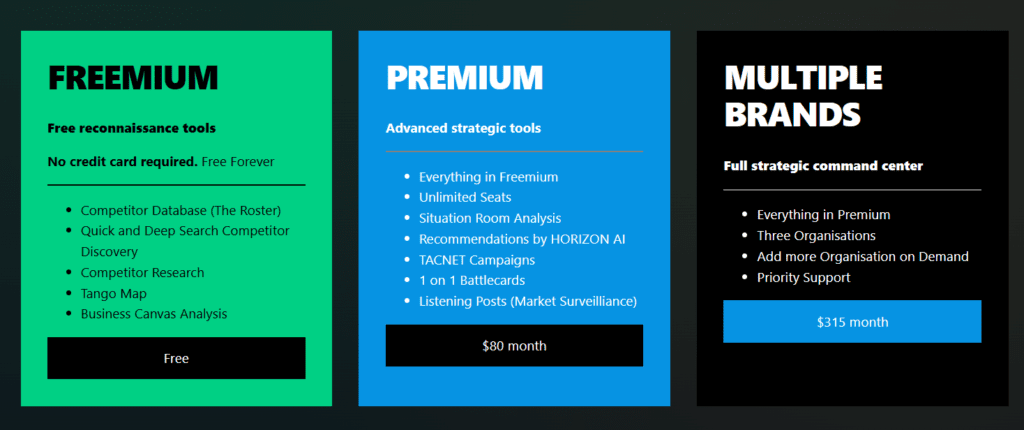
Premium Plan — $80/month
The Premium plan includes everything in Freemium, plus:
- Unlimited seats
- Situation Room Analysis
- HORIZON AI recommendations
- TACNET campaigns
- 1-on-1 battlecards
- Listening Posts
This plan is for teams that need decisions, not only competitor lists.
Multiple Brands Plan — $315/month
This plan includes everything in Premium, plus:
- Three organizations
- More organizations on demand
- Priority support
It is made for agencies, consultants, multi-brand operators, or companies working across different markets. Extra organizations are available on demand at $30 each.
Who Should Use BrandScout?
BrandScout is a good fit for:
- Founders entering a crowded market
- Growth leaders planning expansion
- Consultants doing market research
- Agencies managing multiple clients
- Strategy teams needing faster analysis
- Operators who want to track competitor movement
It is especially useful when decisions need to be made quickly. Not after three months of research.
Pros and Cons
Pros
- Easy competitor discovery
- Free plan available
- Structured competitor database
- Useful strategic frameworks
- Turns insights into campaign plans
- Good for founders and consultants
- Supports multiple brands and markets
- Unlimited seats in Premium
Cons
- May feel advanced for very small hobby projects
- Best value comes when you have real competition
- Premium is needed for deeper strategy tools
Final Verdict
BrandScout is a useful platform for businesses that want better market clarity.
It does more than list competitors. It helps you understand them, compare them, analyze your position, and build a plan from that knowledge. That is the real value.
The free plan is strong enough to start with. You can map your competitors, research them, and build a clearer picture of your market. The Premium plan becomes more interesting when you need deeper analysis, recommendations, battlecards, and campaign planning.
So, is BrandScout worth it?
Yes, if your business operates in a competitive market and you want smarter decisions without spending weeks in manual research. It gives structure. It saves time. And most importantly, it helps you see the market before the market surprises you.

