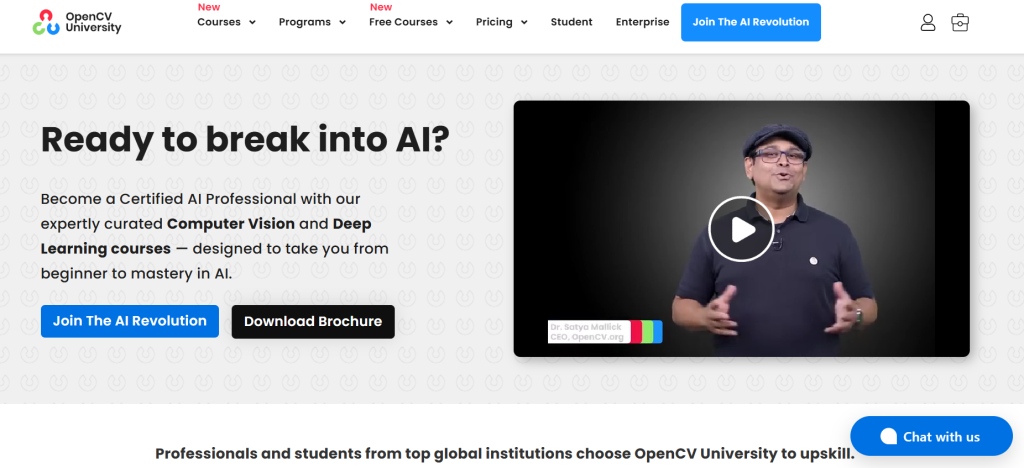
The programs and courses at OpenCV University provide a structured, project-based learning path in Computer Vision, Deep Learning (utilizing frameworks such as PyTorch and TensorFlow), and Generative AI. The curriculum focuses on hands-on coding and practical projects, helping learners build both technical expertise and a portfolio of real-world applications. With official certification and round-the-clock support, OpenCV University provides a reliable and career-focused way to upskill, making it an excellent choice for anyone looking to advance or start their journey in Computer Vision and Artificial Intelligence.
Who Does This Actually Help?
- Students and Developers who prefer to build real projects, not just study theory.
- Working professionals aiming to strengthen their resumes with portfolio-ready projects and official certifications recognized in the AI community.
- Teams and Organizations seeking structured training that bridges classical computer vision, modern Deep Learning, and Generative AI in a single ecosystem.
- Enthusiast or someone planning to switch careers, who wants guided, project-based learning that makes the transition into AI practical and credible.
Course-by-course highlights
1. Mastering OpenCV with Python (MOCV)
The course covers a comprehensive range of topics in computer vision. It begins with foundational concepts, including basic image operations, histograms, color segmentation, and video processing. The course progresses through more advanced techniques, including Contour Analysis, Morphological Operations, Lane Detection, and Image Restoration.
Specialized topics include OpenCV Deep Learning module, Augmented Reality using ArUco markers, and various Object Detection and Tracking methods. The course also covers Human Pose Estimation, Person Segmentation, OCR, and building games using Computer Vision. It concludes with the deployment of a web app using Streamlit.
2. Fundamentals of Computer Vision and Image Processing (CVIP)
The classic toolkit with bite: Filtering, Thresholding, Morphology, Canny, Hough, seamless Cloning, Inpainting, features with RANSAC, and Tracking. Available in Python and C++ versions. The course emphasizes hands-on learning through assignments and projects. You will learn Advanced Image Processing and Computational Photography, Geometric Transformations, Feature Matching, Recognition, Video Analysis, and more.
3. Deep Learning with PyTorch 2.x (DLPT)
A comprehensive introduction to modern Deep Learning Techniques, combining theoretical foundations with hands-on implementation. Starting with the basics of Neural Networks, it gradually advances to Convolutional Architectures, Segmentation, Object Detection, GANs, and Pose Estimation. Throughout the course, learners work on multiple projects, including Kaggle Competitions, to gain practical experience in building, training, and deploying models. The curriculum emphasizes best practices, scalability, and reproducibility in Deep Learning workflows.
4. Deep Learning with TensorFlow and Keras (DLTK)
A complete foundation for building and deploying Deep Learning models using two of the most widely adopted frameworks in industry and research. Starting from Neural Network basics, the course covers Convolutional Networks, advanced training techniques, Segmentation, Object Detection, GANs, and real-world applications with Mediapipe. Learners gain hands-on experience through multiple projects, including Kaggle competitions, ensuring both theoretical understanding and practical skills.
5. Advanced Vision Applications using Deep Learning and Transformers (TXAP)
This course covers Deep Learning for Computer Vision, beginning with Binary Classification and CNNs and extending to advanced areas like Object Detection, Segmentation, OCR, Tracking, Keypoint Estimation, Face Recognition, and Vision-Language Models. Learners practice through structured assignments and projects.
The course integrates case studies (e.g., Global Wheat Detection), Transfer learning, Fine-tuning (including ViTs with attention visualization), and a bonus module on Vision Language Models for complete, end-to-end exposure.
6. Mastering Generative AI for Art (GEN AI)
The course teaches how to harness the power of GenAI using state-of-the-art models. You will learn DALLE2, Midjourney, Stable Diffusion, Flux, and dive deeper into advanced editing methods using DreamStudio, img2img, InstructPix2Pix, and ControlNet.
Moving ahead, the course takes you through fine-tuning Stable Diffusion models using DreamBooth and LoRA. Textual Inversion, Video Generation, and play with Deepfakes using DeepFaceLab.
Projects you can present after completing the course
- Deployed Streamlit CV utilities
- Building HCI (Human-Computer-Interactive) Applications
- Custom Object Detection Notebooks
- Demonstration Video Analysis using Optical Flow
- Fine-Tuning Stable Diffusion Models
- Applications using Advanced Image Analysis Techniques
- Object Counting
- Person Detection
- Human Pose Estimation
- Sports Analysis, and more.
Pattern: Learn, Implement, Package, and when satisfied, Deploy it. Hiring managers like this rhythm.
Certifications and Learning Experience
- Tiered certificates that reflect completion and performance
- Code-first approach with guided notebooks and quizzes
- Active support by Experts when a metric tanked or an install got spicy
- CVDL Master Program that covers end-to-end training in Computer Vision and Deep Learning, combining theory, coding, and deployment.
Strengths that Stand Out
- Practice first. Videos support the code, not the other way around.
- Classic CV, Deep Learning, and GenAI appear in one ecosystem.
- Measurement mindset. IoU, AP, and mAP are standard parts of the cadence.
- Real-world tooling. RunPod, Kaggle, A1111, and friends keep exercises grounded.
Balanced Notes That Set Expectations
These are not negatives. Think of them as “know-before-you-enroll” perks with fine print.
- Self-paced is a superpower, but a calendar still wins. Quizzes and projects help maintain momentum.
- Two frameworks mean a broad range. Depth comes fastest once a primary stack is chosen for ongoing projects.
- Starter notebooks save time. Standing out comes from extra datasets, ablations, and a sprinkle of deployment polish.
- Cloud-first tips reduce friction without a local GPU. Budget a bit of runtime or lean on community tiers.
- GenAI coverage is strong for images. Niche video or 3D workflows will need extra exploration.
- Certificates carry weight in CV circles. Pair them with public repos and live demos for maximum punch.
- Career help is practical and honest. Guidance yes, guarantees, no.
- Classic CV math is accessible and usable. Theory purists can add a textbook for deeper proofs.
What Could Improve?
- The self-paced format rewards consistency. The structure exists, but the habit must be yours.
- Covering PyTorch and TF/Keras is great for breadth. The big gains after graduation come from doubling down on one stack.
- The video platform does not have much control over the quality settings. You can open it on YouTube, but it would be nice to have the feature built into the platform.
Why the Free Bootcamps Are the Perfect Place to Start
The free bootcamps are an amazing way to start your journey in AI and computer vision. They provide a strong foundational understanding that helps you know exactly how to proceed further. The quality of the content is outstanding, with clear explanations, hands-on exercises, and real-world applications. Learners love the structured, practical approach that makes complex topics simple and actionable. Overall, these bootcamps are the perfect starting point which is high-quality, free, and truly transformational for beginners.
Bottom Line
OpenCV University delivers a lively, project-forward path across classic Computer Vision, Deep Learning, and GenAI. The curriculum is organized, the outputs are portfolio-friendly, and the certifications signal “ready to build.” Bring discipline and curiosity, and the program returns the favor with skills you can show.

